By the late Seventies, Burgess had received a series of TV biblical commissions to write scripts for adaptations of, firstly the Moses story starring Burt Lancaster, and later the New Testament. He was averse to wasting work, so he repurposed his research and writing for these various televisual commissions into novels, and hence his work on Jesus of Nazareth (1977), directed by Franco Zeffirelli and starring Robert Powell as a blue-eyed Christ, was reworked into the novel Man of Nazareth, which is notably different to the screenplay and perhaps closer to Burgess’s own conception of Jesus.

There is an inevitable process of translation and interpretation, complicated in no small measure by theological concerns, when attempting to render an understanding of the Bible. Indeed, the mere act of comprehending it led to the development of exegesis, the act of explaining which underpins literary criticism and a number of other critical disciplines. The Bible is a heterogenous set of works written over a lengthy period of time by many authors and in a range of ancient languages. There have been attempts, such as Mel Gibson’s The Passion of the Christ (2004), to adapt Biblical narratives in the languages of the Biblical era, However, the process initiated by the Septuagint in the third century, of rendering the Bible into the contemporary language of believers (and by extension non-believers also) is much more common. Jesus of Nazareth was transposed into the language of global television – English. Burgess, however, aspired to retain a slight flavour of the original in his own work.
The archives of the International Anthony Burgess Foundation in Manchester have documents which Burgess prepared for a novel on the life of Christ he intended to write in the early 1970s. This later informed his work on Jesus of Nazareth, which in turn influenced his eventual novel on Jesus, Man of Nazareth. In a 1972 interview, then unpublished but later to appear in the 50th anniversary edition of A Clockwork Orange edited by Professor Andrew Biswell, Burgess revealed that this would feature an invented language, a kind of fusion of English, Arabic and Hebrew, not structurally dissimilar to how Nadsat features Russian grafted onto English:
“At the moment I’m working on a novel about the life of Christ. In this book I see Christ as a sort of hippie, an early type of revolutionary. I think it’s curious that he was a carpenter, and the fact that he worked with pieces of wood all his life. When it was time for him to die, when he looked at that piece of wood, he must have thought something. I am working with a language for the book now, something – like the nadsat language in A Clockwork Orange – using a fusion of two languages – in this case, English and Hebrew.”
Only three paragraphs from chapter one survive, and are now in the Burgess Foundation archive. They begin:
“‘Not thee, yeled,’ they yelled. ‘We who have been catching samaki are going to be catching raguls now, and thou art a catcher only of evil-reeking smoke or aschan in the ria or lungs, and none of this, yedid, is for thee.'”
This parses easily enough along the lines that Burgess used to render Nadsat comprehensible to readers on first encounter. Terms are embedded in contexts which suggest their meaning (eg ‘yeled’, meaning ‘boy’ in Hebrew, as a dismissive form of address) or else are cleverly glossed by the speaker for the addressee, and by extension the reader, as with “aschan” defined as smoke, and “ria” as lungs. ‘Yedid’, meaning beloved, is obviously intended sarcastically. (It is also found in Earthly Powers as the name of Adam’s same-sex partner in a gay rewrite of the story of Eden created by the novel’s protagonist, Kenneth Toomey.)
Samaki, an Arabic word meaning ‘fish’, and ‘raguls’, Arabic for men, are not immediately obvious, but as with A Clockwork Orange, one assumes Burgess intended for their meaning to become apparent through repetition and context. In any case, the meaning here is to suggest the line attributed to Jesus in Mark’s gospel (1:17): “Come, follow Me,” Jesus said, “and I will make you fishers of men.”
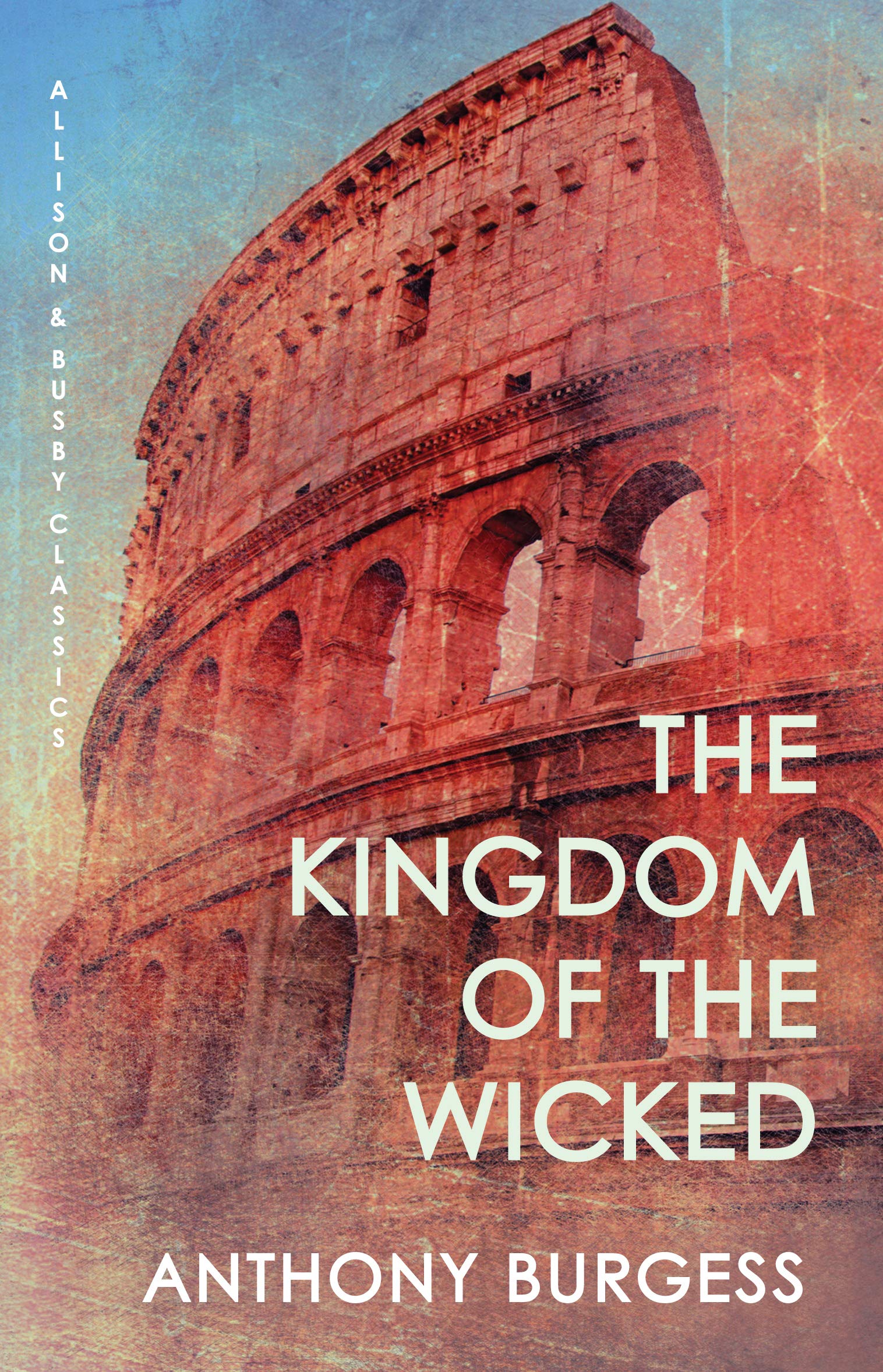
We find ‘yeled’ again in the sequel novel, Kingdom of the Wicked, which is broadly based on the Acts of the Apostles, and which derived from the work Burgess did on the script for AD, the sequel series to Jesus of Nazareth, in 1985. In a brief interlude between two servants discussing John the Baptist, Burgess depicts one who macaronically blends Hebrew and Arabic with Greek (English standing in for Greek in Burgess’ text) In lieu of excavating the actual Aramaic terms for these words, Burgess uses the related Semitic languages Hebrew and Arabic somewhat interchangeably, as he did in his early drafts for Man of Nazareth, to signify Aramaic. Perhaps this is because, being current languages, the Hebrew and Arabic terms might be more recognisable to readers. Alternatively, as he carefully embeds them just as he does Nadsat terms in A Clockwork Orange so that their meanings are clear, or at least discernable, it may be that Burgess was disinclined to pause his creativity to squirrel around in Aramaic dictionaries when he could use terms he was somewhat more familiar with. Here is the passage from Kingdom of the Wicked:
“’The man that was supposed to have his rosch cut off.’ She had the habit of mixing her nurse’s Aramaic into her Greek. ‘The one who used to catch dagim and then preached, the one with the white sakan,’ stroking her pretty smooth chin.
‘Speak plainly, child.’ Her father was up on his elbow, looking at her fiercely.
‘Well, they were all talking about it in the schuk, so old Miriam said, they knew the old yeled whose rosch was really cut off, some of them saw it after it was done, the rosch I mean, and said that’s old whatsisname. And the other one, he got away, and he’s alive in somebody’s cellar, there was a naarah who saw him, she thought it was his ghost at first but it wasn’t. There’s been a bit of trickery, old Miriam said, and it’s a king’s job not to be tricked, she said. That’s what I heard in the kitchen,’ Bernice said.”
In this brief section, Rosh or rosch is Hebrew for ‘head’, dagim are ‘fish’ in the sense of food, ‘sakan’ is Arabic for house, schuk, or souk, is Arabic for ‘market’, while ‘naarah’ is Hebrew for ‘girl’.
There is no attempt, as with Gibson’s The Passion of the Christ, to reproduce the Aramaic of two millennia ago. Nor does Burgess attempt to repurpose the still extant Eastern Aramaic dialects for use. Instead, in both Biblical novel adaptations, his chosen methodology involves a combination of the two most prominent Semitic languages, Arabic and Hebrew, to give a linguistic flavour of the era, albeit one which is no more authentic than the English spoken by Robert Powell in Burgess’s telescript. Burgess’s biblical rewrite is not a paleolinguistic recreation so much as a macaronic invented language, in other words.
One thought on “Anthony Burgess’s other invented languages Part 5: Rewriting the Bible”