It is forty years since Russell Hoban’s novel Riddley Walker was first published. The post-apocalyptic dystopia, set in a Kent thousands of years after a nuclear holocaust, has been a lowkey but pervasive influence on SF ever since its publication. The novel, which is written in the idiosyncratic dialect of eponymous protagonist Riddley Walker, has enjoyed a cult following for some four decades. Now academics, artists and writers are celebrating that fact with a series of events in Canterbury, where many of the events of Riddley’s story are set some centuries in the future.
Read moreDid you mean ‘forella’ or ‘soomka’?
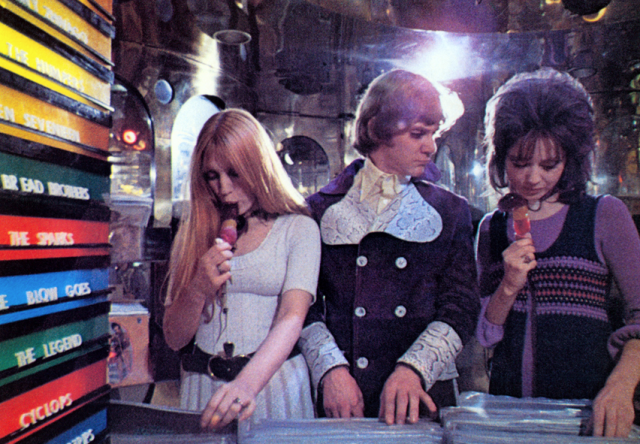
Overlexicalisation as a problem for translators
We’ve talked elsewhere about Nadsat’s function as an anti-language or the language of an ‘anti-society’, a group that sets itself up as in opposition to society and its norms (Michael Halliday first wrote about this phenomenon in 1976 while Roger Fowler drew attention to Nadsat as anti-language in 1979). What we didn’t go into was how Burgess’s understanding of this social phenomenon shows through the way Nadsat is organised and the types of words it includes.
Burgess was a great admirer of Eric Partridge’s fascinating Dictionary of Slang and Unconventional English and knew that words in anti-languages tend to group around a fairly limited set of specific meanings. Partridge’s Dictionary is just one in a long line of works – stretching back at least to 16th century glossaries of thieves’ cants – that have tried to demystify the strange words used by outsiders, labelled by insider society as rogues and scoundrels.
Read moreThe Lady in the Lake, a rat behind the arras and the meaning of ‘translation’
Arthur: The Lady of the Lake, her arm clad in the purest shimmering samite, held aloft Excalibur from the bosom of the water signifying by Divine Providence that I, Arthur, was to carry Excalibur. That is why I am your king!
Dennis: Listen. Strange women lying in ponds distributing swords is no basis for a system of government. Supreme executive power derives from a mandate from the masses, not from some farcical aquatic ceremony.
Monty Python and the Holy Grail
Monty Python inadvertently touched on a major debate among translation theorists, as raised in Umberto Eco’s thought-provoking and entertaining book Mouse or Rat. Eco makes much of his guilt at having to criticise Roman Jakobson for potentially causing ‘confusion’ in his 1959 article ‘On Linguistic Aspects of Translation’ (a piece notable enough to merit its own Wikipedia article).
According to Jakobson, any particular word may be interpreted, or translated, in three ways:
Read more