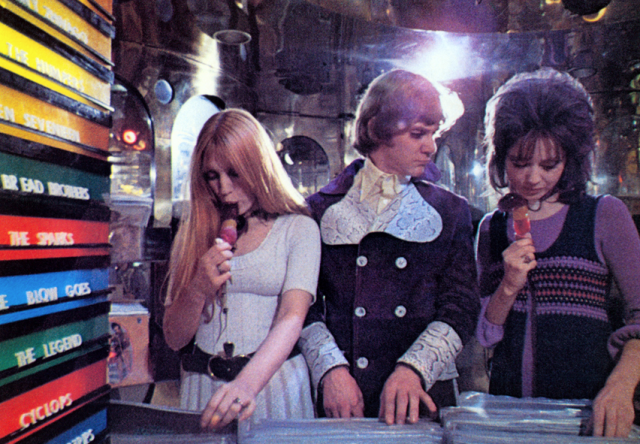
Is there such a thing as Turkish Nadsat?

In a post back in February (apologies for the rather long gap) we discussed in broad terms the situation with Turkish translations of A Clockwork Orange, Otomatik Portakal (literally “Automatic Orange”). Our initial look at the two translations suggested that Nadsat had been largely suppressed – there was no real evidence of it as a separate anti-language. This post looks at the later and more rigorous Körpe translation in more detail to examine what happened and discuss whether there even is such a thing as Turkish-Nadsat. This post is based on work we recently presented at the fascinating I-conlangs 2022 conference held at the University of Turin. [Our slides for the presentation can be seen here.]

Read more

The Mysterious Case of the Missing Nadsats

Ponying the Slovos began as an attempt to define Nadsat, the invented language at the heart of Anthony Burgess’s A Clockwork Orange, and then examine how translators dealt with it. We believed that by isolating and examining the translation of an invented language, which does not emerge from an organic culture, it would help to reveal translator’s various strategies for translation more obviously.

Read more

Did you mean ‘forella’ or ‘soomka’?

Overlexicalisation as a problem for translators

We’ve talked elsewhere about Nadsat’s function as an anti-language or the language of an ‘anti-society’, a group that sets itself up as in opposition to society and its norms (Michael Halliday first wrote about this phenomenon in 1976 while Roger Fowler drew attention to Nadsat as anti-language in 1979). What we didn’t go into was how Burgess’s understanding of this social phenomenon shows through the way Nadsat is organised and the types of words it includes.

Burgess was a great admirer of Eric Partridge’s fascinating Dictionary of Slang and Unconventional English and knew that words in anti-languages tend to group around a fairly limited set of specific meanings. Partridge’s Dictionary is just one in a long line of works – stretching back at least to 16th century glossaries of thieves’ cants – that  have tried to demystify the strange words used by outsiders, labelled by insider society as rogues and scoundrels.

Read more